Showing posts sorted by relevance for query bear. Sort by date Show all posts

Monday, May 17, 2010

Niles - Significance and Historical Context

Researching and writing helped along by roses from my front garden and a souvenir bear from the Niles Town Plaza celebration held the first weekend in May. His shirt has a picture of the new plaza featuring the train depot and the Niles foothills in the background.

Niles – Significance and Historical Context

Niles being the final leg of the transcontinental railroad had statewide significance for the railroad brought to California a mode of relatively fast and safe transportation for both people and freight. Considered the top engineering feat of the 19th century, the railroad enabled people to travel from the East coast to the West within days rather than months. The railroad created the ability to move goods easily in and out of the state; for Niles, it enabled the local nurseries and fruit farmers to sell their goods to a greatly expanded market beyond San Francisco. The completion of the transcontinental railroad fostered economic development and immigration not just for Niles, but for California and the West as a whole.

My topic was both the coming of the railroad to Niles and how it affected the growth and expansion of the local nurseries and fruit farmers. Today Niles has an extremely strong historical sense of the train and the town utilizes the Niles Canyon Railway to bring tourists and tourist dollars to the local economy. While everyone is familiar with the role of the train, many are unaware of Niles’s horticultural heritage. This important part of Niles’s past could also be used to bring people and money to the local economy in the form of a farmer’s market held on the old California Nursery Company grounds. More about that in next week’s blog.

Both the railroad and the presence of the Chinese were prime examples of conflict in California, one of the overarching themes of the class. Not everyone was happy with how the railroad was built or the immense power the railroad maintained in state economics and politics, and we have talked about the Chinese Exclusion Act of 1882 in class.

My timeframe has ended up stretching from Ohlone days through to today, so my historical context is all-encompassing. I have looked at pre-history in California, the mission days and the creation of Mission San Jose, the Californios and the Land Act, the development of local horticulture from the late 1850s through the 1930s, the Chinese presence in California agriculture, and the coming of the transcontinental railroad. Next week I’ll be focusing on the Roaring 20s and how the population boom of that decade allowed the California Nursery Company to really expand. I will also take a look at the Great Depression and how that adversely affected this powerhouse of a business.

Niles’s train history and horticultural history are shared by other parts of the Bay Area. The train brought all of its effects to the entire state and most of the Bay Area (with the exception of San Francisco) has a strong agricultural past—along with many Chinatowns—up until WWII. What is great about Niles is that so much of the railroad and horticultural pasts are still around today. Nostalgia is definitely a large part of Niles’s identity today, not to mention a large part of its charm.

Monday, May 3, 2010

Niles - A Timeline

Sweetpeas and roses growing in my front yard.


I always put a timeline together before I start writing a paper or article; it helps me synthesize information from various sources and often makes connections more obvious. It also usually shows me what information I should still be looking for, so it is well worth the time it takes to create it. This timeline got longer than I anticipated because I am linking the railroad and nursery aspects of Niles’s past to Niles’s present and future, therefore I had to look beyond the 1860s-1930s timeframe I had originally envisioned. Seeing how many other additional businesses and commerce were in and around Niles beyond the railroad and nurseries has let me better understand the bustling community Niles was for most of the twentieth century, and how limited today’s businesses and commerce are in comparison. The reliance on the railroad as a part of Niles’s past to bring people into the area to visit today’s concerns—most of which are antique or collectible shops, and the three or four restaurants and cafes--is quite clear.

Now I can see how my experience of living in Niles for the past year compares to Laurie's experience of spending her entire life here. She saw her father work for the Pacific Steel Compnay and be an active union man. She grew up with shops and stores that served the community's needs. There are still a handful of them within Niles but they have definitely been eclipsed by the antique and collectible stores. I do wonder how much of this change is caused by the inevitable results of American society changing, e.g. Mom and Pop stores getting replaced by super-sized grocery stores and individual businesses getting supplanted by shopping malls. Although Laurie feels she is looking to Niles's future, could she also be longing for Niles to return to the past of her childhood?

Niles Timeline

1776 – de Anza crosses Alameda Creek

1797 – Mission San Jose founded; immense garden started following year from Santa Clara Valley cuttings

1821 – Mexico gains independence from Spain

1834 – start of mission secularization

1835 - Don Jose y Jesus Vallejo made administrator of Mission San Jose

1841/42 – Don Jose y Jesus Vallejo granted 17,705-acre ranch (Rancho Arroyo de Alameda); Vallejo built an adobe grist mill (Vallejo’s father engineer of several mission irrigation systems)(JJ is Mariano Vallejo’s nephew)

1842 - JJ built adobe about a mile from the mill on what became CA N Co land; adobe is still there today

1846 – John C. Fremont orders food and supplies commandeered from VM (Bear Flag Revolt)

1846 – Mormon John Horner arrived, bought land adjacent to Mission San Jose (today’s Union City), begins growing wheat and fruit; “Fast transportation is the key to a successful economy,” est. steamship and stage delivery to SF and SJ

1846-48 – War with Mexico; discovery of gold

1849 - Gold Rush!

1850s-1860s – squatters on Vallejo’s land; 145 lawsuits over land ownership; many seeds, cuttings and grafts made from Mission garden plants by squatters

1850 – 1st vineyards planted; CA made a state

1851 – Land Act

1853 – prefab Gothic-style houses arrive via Cape Horn; Alameda County formed; Sim and Flint plant 1st orchards in Niles (apples, peaches, pears, plums); Nichols obtains trees from east, plants next to Sum and Flint

1854 – Sim plants his 1st orange trees, Nichols pears

1856 – Vallejo builds a second mill; the foundation is still standing in Vallejo Mills Park; Lucy and James Shinn arrive to manage brother-in-law Dr. Joseph Clark’s 250 acres purchased from Sim; Shinns eventually gain title to 150 acres from Clark

1858 – Vallejo’s ranch confirmed by James Buchanan, but many acres sold to pay court costs

1860 - Civil War started; Overackers arrived

1861 – Alameda Creek flooded; adjacent properties under 3 feet of water

1865-66 – Western Pacific RR constructed from San Jose to Farwell (1/2 way point in Niles Canyon)

1867 – Shinn place expanded to 300 acres; Shinn and Clark form partnership to start nursery with import trade from Asia, demo Japanese garden on property

1868 – 1st gravel mining operation

1869 – last transcontinental link RR terminus in Niles (Leland Stanford) true “last spike” driven in at Niles 8 Sept 1869; RR leases mills for a year while track was laid, rebuilt aquaduct with masaonry; Vallejo’s son subdivides 23 small plats around mills and other bldgs = Vallejo Mills

1870 - 1st Central Pacific train depot, called the Niles Station after CPRR attorney

1870s –wagon bridge built over Alameda Creek, 1st school at VM

1873 – 1st Niles post office (at general store)

1876 – Shinns built family home after 20 years living in Sim cottage

1879 – 1st garden book in CA (Shinn’s Pacific Rural Handbook)

1880s – 1st church; grist mill closed, 1st town hall

1882 – Harrison Mayhew buys land next to VM; orange orchard on top of old corrals (excellent effect from manured soil)

1883 – 1st female editor CA lit journal (Milicent Shinn)

1884 – 1st horticultural agribusiness (CA Nursery Co est, by John Rock and 3 partners; Vallejo adobe used as fumigating house); Southern Pacific RR Co created, formally registers Niles town plat (separate from VM, now “Old Town”)

1888 – town of Niles platted

1889 – Niles Grammar School built

1894 – 1st big freeze to impact local orchards; puts end to orange growing in area

1897 – Niles Canyon Picnic Grounds est. with dance pavilion, restaurant, bath house (indoor swimming pool), dock for boats

1898 – 1st female PhD UC-Berkeley (Milicent Shinn)

1900s – 1st free library, bank and movie theater

1901 – Fernbrook Park (Niles Canyon); at some point Stonybrook Park (old Farwell stop in Canyon) created for daytrippers

1901 or 1904 – Southern Pacific depot at Niles built (accounts vary)

1904 – John Rock dies

1910s – 1st grammar school, kindergarten

1911 – Alameda Creek flooded; 1st Niles rental flats built by Italian Manuel Domenici; Niles Jail built

1912 – 1st movie studios in N. CA (Essanay Studio leases a barn for a year)

1913 – Essanay builds their own studio on Front St. with bungalows on 2nd St.; Edison Theater built (today home of Essanay Museum)

1914 – WWI started

1915 – Niles Day at Panama Pacific International Expo; Niles Courthouse built

1916 – Essanay relocates to Hollywood

1917 – Alameda Creek flooded; eroded southern banks where Italian truck gardens were located; George Roeding bought CA Nursery Co

1920s – Dickey Mastertile and Kraftile (on old CA N Co land)

1924 – 1st poultry genetics-breeding farm; Niles Theater opened

1926 – NILES letters go up on hillside above town

1929 – Niles Veteran Hall dedicated (2nd St.); Stock Market crashes

1930 – 1st chain garden retail stores; Niles-Alvarado Rd. cuts through to Niles; George Rodeing restores JJ Vallejo’s adobe

1932 – Joe’s Corner built with Kraftiles

1933 – worst year of the Great Depression

1937 – entry gateways built (overpasses); WPA project

1938 – Pacific States Steel Corp. under construction; union office in Niles

1939-ground broken for 3rd Niles Grammar School (2nd St.)

1940s – last passenger train stopped in Niles; 1st sighting of Niles Canyon ghost

1941 – Pearl Harbor; official Am involvement WWII

1947 – Florence Mayhew Shinn takes over Shinn Nurseries with son Joseph until 1967

1950s – 1st female town council, 1st Essanay Days Parade

1955 – last Alameda Creek flood

1956 – Fremont incorporates five towns, incl. Niles

1959 – Niles Theater burnt down

1960s – 1st Annual Niles flea market; Army Corps of Engineers started re-designing Alameda Creek into flood-control channel; Niles Community Park opened

1962 – FMShinn gives property for Shinn Park to city

1970 – 1st fabridam on waterway (Alameda Creek); used to divert creek into recharge ponds

1972 – Niles community effort to save Vallejo adobe; Roeding gave 20 acres of land for park

1978 – Pacific Steel factory closed (largest # employees = 450)

1970s – last CA Zephyr train run

1984 – Niles Depot moved down Mission Blvd.; Niles Canyon Railway track built to replace torn out SPPR track

1987 – Niles Canyon Railways started running tourist trains between Niles and Sunol through Niles Canyon

1990 – reconstruction of NILES letters; big freeze

1990s – 1st Niles Dog Show, Bronco Billy Film Festival, Wildflower and Art Festival

late 1990s – last to-pick apricot orchard closed

1995 – last gravel pit closed; regrading of pits allowed Niles Cone aquifers to recharge and help supply water to area

1996 – Kraftile closed

2000 – Quarry Lakes opened as a park

2002 – metal graphic banners installed; part of Laurie’s Disneyland complaint?

2004 – WWI Memorial Flagpole reconstructed

2010 – SPPR depot moved back to Niles Blvd., Niles Central Plaza completed; Niles firehouse rebuilt from old bldg., made to look old with more metal graphic panels installed on building side, definitely part of Laurie’s Disneyland complaint

Niles - Vallejo's Mill (Take Two)

This 1874 map of Niles shows the location of Vallejo's mills and a small cluster of nearby buildings. The Shinn property can be seen bisected by Alameda Creek with William Sim's acreage directly below. Sim and his wife built another house to live in; their original cottage now belonged to the Shinns. The current town of Niles was platted onto the area marked by the finance company, east of Vallejo's Mill and north of Alameda Creek.

Here is William Sim's cottage that Lucy and James Shinn lived in for 20 years before building their large family home. Note the vegetation enfolding the house; for a blacksmith, Sim was really into horticulture! He experimented with a lot of hybridization, especially with fruit. Shinn wrote that Sim was a hard drinker who one day tried to playfully (!) put his wife into a barrel of flour headfirst. Shinn did not say whether or not Mrs. Sim matched her spouse in alcohol consumption or what she thought about the barrel escapade.

Here is Sim's cottage today in Shinn Historic Park and Arboretum.


Niles has two entrances from Mission Blvd. One is the Sullivan Underpass and this one is the corner of Niles Canyon Rd. where it crosses Mission Blvd. and turns into Niles Blvd. I walked over to Vallejo Mills Historical Park from my home along the creek and then climbed up to Mission Blvd. and crossed to the park.

Here is the view from Mission Blvd. (the Niles sign is right at my back) towards the park.

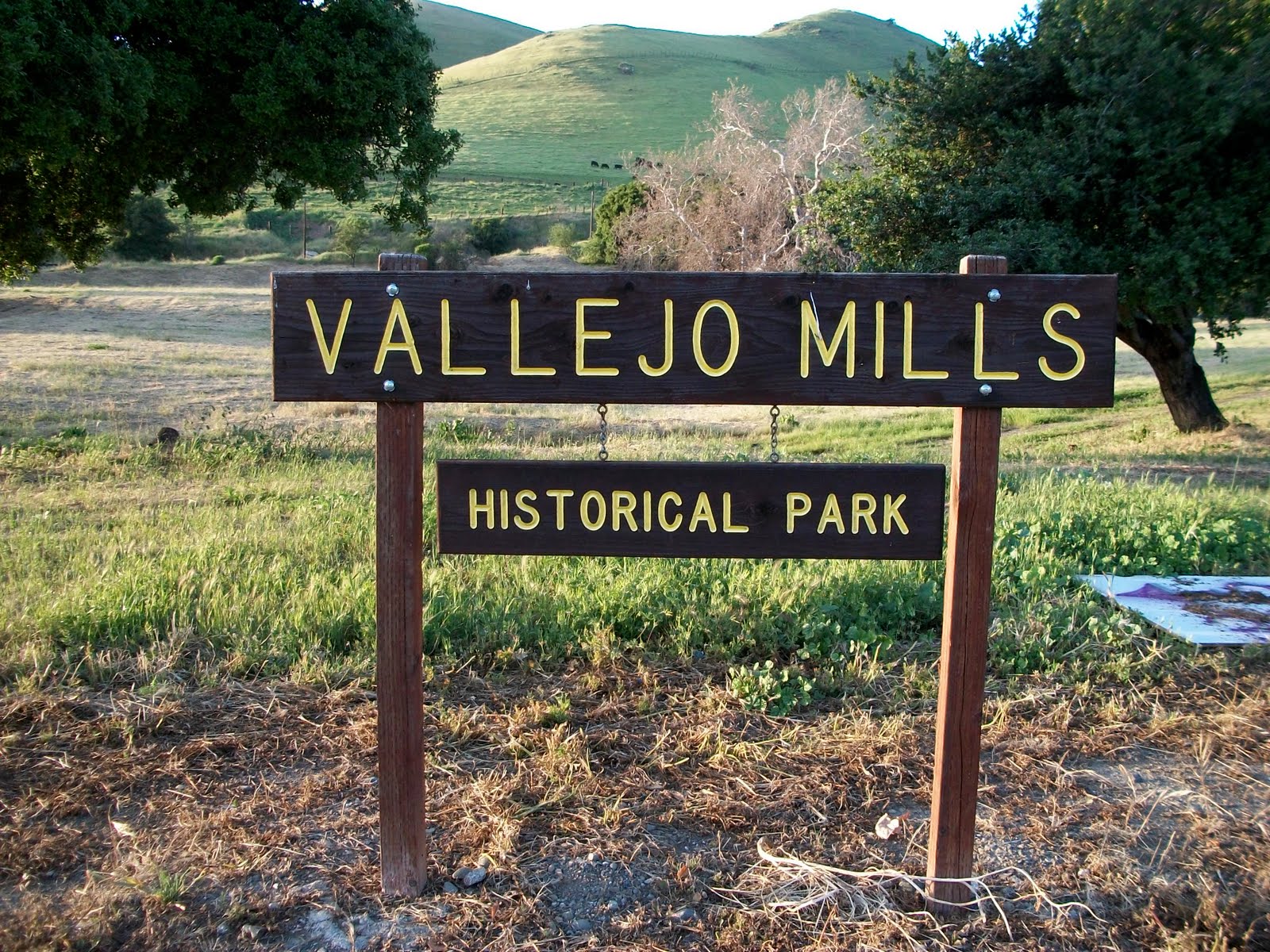
There is a state Historical Landmark sign at Mission Blvd. which I have driven past about eight million times without seeing. After a first visit to the park where I could not find the remains of the mill, I went back along Mission Blvd. to be sure I was at the right place. I was.


Another sign I've driven past eight million times. At the corner of Mission Blvd. and Niles Canyon Road but facing Mission only. If you are approaching the park from the canyon you have already missed the very low-key entrance.


Walking up to the foundation of Vallejo's second mill that was completed in 1856.


One of the exterior walls.


Looking down into the interior of the mill's ground floor level. The upper two wooden stories are long gone.


Bailey out in the field with me, exploring the mill interior.


Looking from the mill back towards the intersection of Mission Blvd. and Niles Canyon Rd.


More poppies. One of the best parts of spring.

Just above the mill, the tracks head towards Niles. The tracks are situated on top of an overpass just before the Mission Blvd. and Niles Canyon Rd. intersection.


Facing the opposite direction, these tracks (and Bailey) are headed towards Sunol, six miles away.


The one small irrigated stretch of lawn in the entire park.


A poppyless view towards Mission Blvd.


Backtracking towards home, here is a glimpse of Alameda Creek through pepper tree leaves. The Army Corps of Engineers built levees along the creekbed when they put in flood control. The creek seriously flooded Niles several times over the years and caused much damage. These levees are now pedestrian/bike paths that start in Niles Canyon and end 11 miles away at Coyote Hills, right on San Francisco Bay.


Alameda Creek right where I enter and exit the park at the end of L St.


There are always ducks and geese and other birds I cannot identify in the water.


Bailey loves living close to the creek where she can legally be off-leash.


In my first blog I promised I would find out why Niles was once called Vallejo Mills, Vallejo’s Mills, and Vallejo’s Mill; I’ve seen it written each way on various old maps. Charles Howard Shinn claimed squatters also called it “Gopher-town,” but cartographers never recorded this sobriquet! Shinn was the son of Lucy and James Shinn, who came to Niles in 1856 when Charles was just two years old. One of the many things Shinn did as an adult was to write a series of newspaper articles about the history of Niles and the surrounding area, all of which he was very familiar with. These 1899 articles are some of the best primary materials I have come across in terms of an eyewitness account of Niles in the latter half of the 19th century. Shinn was interested not just in horticulture but history as well. He wrote articles about many different aspects of the area and managed to connect them, e.g. the use of schooners from East Bay landings to move goods to the San Francisco market before the railroad was built. I am looking forward to reading all of the articles this coming summer when my time will be freed up by being out of school.

The Spanish founded Mission San Jose in 1797, Mexico won its independence from Spain in 1821 and began secularization of the missions in 1834. Don Jose y Jesus Vallejo (nephew to Mariano Vallejo) was appointed administrator to Mission San Jose in 1835. He and his family lived in an adobe house across from the mission. In 1841/42, he was granted 17,705 acres of the former mission lands. J.J. Vallejo promptly built an adobe house to shelter his majordomo and vaqueros (he was running 10,000 head of cattle) and a two-story adobe grist mill, to turn wheat into flour. Hence the name of Vallejo’s Mill. John C. Fremont stopped here in 1846 to commandeer food and supplies for the Bear Flag Revolt. Hence the later name of Fremont being applied to the larger city that would incorporate Niles in 1956.

J.J. Vallejo built a wooden three-story mill next to the original adobe mill in 1856; perhaps the area then became known as Vallejo’s Mills. These two mills were located at the mouth of Niles Canyon from whence Alameda Creek flowed towards the San Francisco Bay, some 11 miles away. (Mission San Jose today is about a ten-minute drive heading south down Mission Blvd. from Niles and the site of Vallejo’s mills.)

Beverly Bastien wrote about the 1851 Land Act and how Californios like J.J. Vallejo had to prove title to their lands. Vallejo definitely suffered from squatters; he was embroiled in 145 lawsuits over the years. Shinn wrote that “no one could get titles to land” in Vallejo Mills when squatters/settlers began to arrive following the 1849 Gold Rush. While Bastien estimated most Californios spent 17 years in litigation, U.S. President James Buchanan approved J.J. Vallejo’s claim in 1858, only seven years after the Land Act was passed. However, he was forced to sell off much of the land for court costs.

In 1853 blacksmith William Sim and a partner, E.P. Flint of Oakland, were squatting along Alameda Creek just a few minute’s walk from the mills; they planted both wheat and various fruit trees. Sim sent an example of his first growth of wheat to the Crystal Palace in London, England for the “World’s Fair” in the summer of 1853; one stalk stood ten feet three inches high with a single head producing 80 grains and the overall 70 heads producing 4200 grains. Needless to say, this fecundity boded well for the area’s agricultural potential. Shinn wrote that wheat was considered the foremost crop during the 1850s and 1860s, with settlers only planting a few fruit trees, “for the idea of ‘money in the orchard’ was slow to take hold.”

Once it did, fruit was ferried by schooner from landings in the East Bay to San Francisco. With the local market saturated, interest in fruit growing waned until the advent of the railroads. With this new capability of transporting goods relatively quickly over much longer distances, horticultural interest in Niles revived and began to flourish anew. More about that later.

In the meantime, J.J. Vallejo’s son, Plutarcho Vallejo, had studied to be a mining engineer at Santa Clara College (today’s Santa Clara University). In 1869, as Leland Stanford was laying railroad track through Niles Canyon to form the final link of the transcontinental railroad, Plutarcho worked with surveyor Luis Castro to subdivide the area around the two mills and the various other dwellings constructed by Vallejo’s workers. The single street was named Vallejo Street (it was a short stretch of the original mission road, later known as the County Road and finally named Mission Blvd.) with the two mills at one end and 23 lots laid out along both sides of the street.

In 1870, the Central Pacific Railroad Co. built a train depot a very short distance northwest from Vallejo Mills and dubbed it the Niles Station, after Central Pacific attorney Addison C. Niles, who later became a California Supreme Court judge based in San Francisco. Those who did not live in the tiny Vallejo Mills subdivision had property along the south bank of Alameda Creek or acreage along today’s Mission Blvd., either north towards Decoto or south towards Mission San Jose. Today’s town of Niles was platted east of Vallejo Mills and north of Alameda Creek at some point during the 1880s. The Southern Pacific Railroad Co. (the Central Pacific was subsumed by the Souther Pacific in 1884) registered the new plat in 1884, with nearby Vallejo Mills now becoming “Old Town.”

The unroofed walls of Vallejo’s mill (supposedly of the second and larger wooden mill, but they look like crumbling adobe to me; surely those wooden walls must have sat on top of this adobe foundation) can be visited today at Vallejo Mills Historical Park, a state landmark. The walls are quite close to busy Mission Blvd., but are obscured by a sound baffle wall. You can only see them by parking in the rather distant lot and approaching them on foot. The now dry creekbed that fed the mill can be seen and the railroad tracks leading out of Niles Canyon over to Niles can be seen a very short distance away. An enormous eucalyptus tree towers nearby with native coast live oaks providing some much-needed shade at the edges along Mission Blvd. The park has one irrigated stretch of lawn nowhere near the mill remains, with the remainder of the area left to grow as it will. I do not know if this park has always been so modest or if it is reflecting the current state of many California parks due to recent budget woes. It is really cool to be able to view and climb around the former mill.

The sources I used for this blog include; 1) Map of Washington Corners, Haywards Park, Niles, Pleasanton, 1878, 2) Shinn, Charles Howard. Historical Sketches of Southern Alameda County (First Published in the Oakland Inquirer as a Series of Articles June 8 – November 18, 1889) Alameda County Historical Society. Oakland: GRT Publishing, 1991, 3) Holmes, Philip and Jill M. Singleton. Niles Fremont. San Francisco: Arcadia Publishing, 2004, 4) Ockerman, Phil (ed). City of Fremont: the First Thirty Years. San Francisco: Mission Peak Heritage Foundation, 1988, and 5) Bastien, Beverly. “’I Heartily Regret That I Ever Touched a Tile in California’: Henry Wager Halleck, the Californios, and the Clash of Legal Cultures,” California History 72:4 (Winter 1993/1994): 310-323.

Monday, May 24, 2010

Niles - The California Nursery Company and the Roeding Family

I was really happy to find this 1894 page from the Pacific Rural Press which showed two ads for the California Nursery Company of Niles and the Fancher Creek Nursery of Fresno right next to each other. Frederick Roeding, another German immigrant who made his money in banking in San Francisco, had invested in 80,000 acres in Fresno with a group of partners. The property was relatively worthless until the train was put through in 1870 and M.J. Church created an irrigation system that would allow farming in the area. In 1883 Frederick Roeding, in partnership with Gustav Eisen (a fig expert) started the Fancher Creek Nursery. By 1886 he was ready to write the business off as a learning experience but his oldest son, George Christian Roeding, persuaded his father to allow him to run the nursery for a year after his graduation from high school. His father wanted him to attend a university but George was determined to follow his passion for plants.


While George Roeding was successfully building up the Fancher Creek Nursery (in his first year he did not break even, he actually made a profit of $3500, to his father's astonishment and joy), Rock continued his exemplary work at the California Nursery Company. After his death in 1904, the business passed to William Landers. He lived on the property in the house pictured above until his death in 1917. Local legend has it this house was designed by Bernard Maybeck in 1907.
This Pacific Rural Press tribute to George Roeding took a playful poke at his propensity and focus for work, work, and more work, claiming his father had to send George to Fresno to escape the dangers of San Francisco high society! Roeding, who was a personal friend of John Rock, purchased the California Nursery Company from the Landers estate in 1917 and moved to Niles.
A survey of the property made in 1918, allowing George Roeding to assess his new holdings. The key to the map shows quarters for both Chinese and Japanese laborers. As mentioned in the Shinn blog, a San Francisco-based Chinese family worked on both the Shinn and Roeding properties throughout the 1920s and 1930s.

As this California Nursery ad demonstrates, Roeding was a strong believer in the white family farm that Cecelia Tsu wrote about. He publicly wrote against the use of alien labor in 1923: "The agricultural industry in California does not need aliens who cannot assimilate with our people." As Charles Nordhoff noted in his book about California as a potential home, many if not most of the wealthier Californians who spoke publicly against the Chinese hired them privately and, behind closed doors, swore that California as a state could not afford to operate without this labor force.


My research partner ran across this 1910 San Francisco Chronicle article about white family farms and saved it for me; thank you, Marlea! As you can see from the headline, a movement was afoot to extend summer vacation to allow children to help their parents harvest fruit.


This Niles postcard featured the palm-lined entry drive of the California Nursery Company. In the text below, the connection between the railroad and marketing of fruit was made.


Workers at California Nursery, preparing plants for long-distance shipping. George Roeding experimented with different ways to ship both fruit and plants to enable viability.


Roeding set up several roadside distribution points at various highways in California due to the rise of the automobile. He owned additional growing grounds in Loomis and Modesto. This image is of Niles facing Mission Blvd., the main county road that once connected the missions.


Here is an advertisement focused on those new automobile owners.


One section of the growing grounds at Niles during the 1920s, with the President's House and packing sheds seen in the background. The photographer, Gabriel Moulin of San Francisco, was standing with his back to Mission Blvd. and the railroad tracks.


Workers moving palm fronds. They could have been doing cleanup or gathering fronds to decorate a parade float.


The growing grounds were home to hundreds of tress specimens. Though many remain, this gigantic "Big Tree" is long gone.


The Roeding family encouraged casual picnic visitors; this looks like a group of horticultural experts holding a meeting.


These adverisemts were just a few of many that George Roeding Senior kept in a scrapbook, along with dozens of articles he wrote about the nursery business, plants, landscaping (both public and home), the need for parks, auto parks, local and state fairs, and numerous other subjects. The connection between John Rock and the two Roedings, George Senior and George Junior, was unbreakable in terms of the contributions these three men made to the state of California regarding the nursery business and fruit cultivation.


George on horsback at Niles. George's daughter, Mrs. Butler, noted: "When I returned from Europe we used to ride horseback before breakfast practically every day. Those morning rides are indelibly impressed on my memory. The sun coming up behind Mission Peak; eating cherries as we slumped in our saddles; or inspecting the peach and apricot trees, with now and then a taste of fruit when in season" (Kruckeberg, 95).


This local Niles child is standing in front of one of the demonstration gardens in 1926. George Roeding Seniors health was starting to fade at this time, and his son, George Roeding Junior, took over the business. He focused on crop experimentation and allowed UC-Berkeley space for additional experimentation (the university already owned several experimental ag stations).
The original logo of the nursery. Grandson Bruce Roeding told me someone from the state asked that the logo be dropped, possibly due to the bear's presence on the state flag. The California Nursery Company then adoped the Vallejo mission sitting in the middle of the grounds as their new commercial logo.


The Jose de Jesus Vallejo adobe on the California Nursery growing grounds. George Roeding Junior and his wife, Frances, had the mission restored in 1930 and used it as a guesthouse and tea house for visitors.
George Roeding Junior and his wife Frances in 1956.


The last California Nursery Company office, still standing on the grounds today.


The California Nursery Company closed in the late 1960s. I lifted this image from the California Nursery Company Legacy Council website, which shows the layout of the grounds in relation to Alameda Creek and Mission Blvd. Those interested in preserving the history of this nursery can find out more information by visiting the website at http://www.fremontica.com/CNCo/.


The sources I used for this blog were: 1) California Nursery Company and Fancher Creek Nursery advertisements, Pacific Rural Press (29 Dec 1894): unpaginated, 2) “Need White Families in Fruit Harvesting,” San Francisco Chronicle, 5 Sept 1910, 3) “Price List, Fruit and Ornamental Trees,” California Nursery Company catalog, 1 Dec 1898, 4) “The Roeding Family,” Tri-City Voice (12-18 Sept 2006): unpaginated, 5) “Tour de Niles: Historic Biking and Walking Tour” Girl Scouts of Northern California, Coyote Hills Service Unit (Http://www.coyotehillsgs.org/bikeforgold): undated, 6) Duval, Charlene, “Historical Background of the Vallejo Adobe on the Former California Nursery Property, City of Fremont, County of Alameda,” San Jose, CA: Archives and Architecture Consultants, May 30, 1977, 7) Fisher, Robert B. (Dr.) Scene From the Peak: A Pictorial History of Washington Township, Alameda County. Book 3 – Niles (Vallejo Mills). Local Museum of History, undated, 8) Kruckberg, Henry. George Christian Roeding, A Tribute. Los Angeles: California Association of Nurserymen, 1930, 9) California Nursery Co. Legacy Council. (http://www.fremontica.com/CNCo/)(24 May 2010), 10) Holmes, Philip and Jill M. Singleton. Niles Fremont. San Francisco: Arcadia Publishing, 2004, and 11) George Roeding Senior's scapbook (1917-1927), housed at the Museum of Local History in Mission San Jose.